Where Should My Child Begin?
Detailed Starting-Volume Questionnaire — 80 parent-observable questions
How to score each question
Part A: Child's Communication Profile (not scored — for the printed report)
Current Communication Modes
Main Areas of Concern
Sensory Foundation
Regulation for Shared Interaction
My child can remain calm, alert and available long enough to participate in a short shared activity without frequently becoming overwhelmed, shutting down or leaving.
Recovery from Overwhelm
When dysregulated, my child can accept familiar support or use an established strategy to begin returning to a state in which interaction is possible.
Awareness of Sensory Experiences
My child notices and responds meaningfully to sound, touch, movement, light, smell, taste, temperature or body pressure.
Communication of Sensory Needs *
My child can communicate needs such as stop, more, break, too loud, don't touch, move or finished through any reliable communication mode.
Body-Part Awareness
My child recognises important body parts on themselves and responds when a body part is named, touched or involved in a familiar action.
Awareness of Internal Body Needs *
My child shows awareness of hunger, thirst, tiredness, pain, feeling hot or cold, or needing the toilet.
Shared Engagement
My child can briefly attend to another person, an object or a shared activity and remain involved for several back-and-forth turns.
Basic Imitation
My child attempts to copy a simple movement, action with an object, sound, facial expression or familiar play routine.
Matching and Visual Attention
My child can visually attend to and match identical objects, pictures, shapes, colours or other simple visual information.
Response to Familiar Communication
My child responds consistently to their name, familiar gestures, common words, visual cues or simple communication from another person.
Birth of Intentionality
Intentional Requesting
My child independently directs a request towards another person for a desired object, activity, food, action or person instead of only crying, reaching or waiting.
Refusal and Protest *
My child clearly communicates no, stop, don't want, not this or finished in an appropriate and understandable way.
Asking for Help *
My child communicates when help is needed instead of immediately becoming upset, abandoning the activity or waiting for someone to notice.
Making Choices
My child can examine two or more options, make a choice and communicate that choice clearly.
Joint Attention
My child follows another person's point or gaze and can direct another person's attention towards something meaningful or interesting.
Meaningful Use of Nouns
My child understands and uses names of familiar people, objects, foods, animals, places or belongings meaningfully, not only while naming cards.
Meaningful Use of Action Words
My child understands and uses everyday action words during real activities, such as eat, drink, open, go, sit, wash, play or sleep.
Early Instruction-Following
My child follows familiar one-step and simple two-step instructions without repeated physical demonstration or excessive prompting.
Early Questions and Social Responses
My child responds to greetings and answers simple What and Who questions about familiar people, objects and activities.
Commenting and Social Initiation
My child communicates to show, share, greet, comment or begin an interaction, not only to obtain something.
Symbolic Connection
Categorisation
My child groups objects or pictures meaningfully according to categories such as food, animals, clothes, vehicles, toys or household items.
Object Function
My child understands and explains what familiar objects are used for rather than only naming the objects.
Functional Associations
My child connects related objects, people, actions or places, such as toothbrush-toothpaste, cup-water or doctor-hospital.
Descriptive Language
My child describes an object, person or experience using meaningful features such as colour, size, shape, texture, condition or appearance.
Contrast Concepts
My child understands and uses contrasts such as big-small, hot-cold, empty-full, wet-dry, same-different or fast-slow.
Pronouns and Sentence Relationships
My child understands common pronouns and connects the correct person or subject with an appropriate action.
Similarities and Differences
My child identifies how two items are alike and how they are different, using more than one feature when appropriate.
Part-Whole and Odd-One-Out
My child identifies parts of familiar objects and explains why one item does not belong in a group.
Expanded WH-Questions
My child answers varied What, Who and Where questions beyond familiar, repeated or memorised examples.
Visual Discrimination and Flexibility
My child notices meaningful visual differences, selects from similar alternatives and adjusts when examples or presentation change.
Community Competence
Understanding Daily-Living Sequences
My child understands the steps in familiar routines such as dressing, bathing, brushing teeth, preparing food or getting ready for school.
Explaining or Arranging a Routine
My child can arrange pictures or verbally describe the steps of a familiar activity in the correct functional order.
Before and After Concepts
My child understands and uses before and after when discussing routines, instructions or events.
Time and When Concepts
My child understands morning, afternoon, evening, yesterday, today, tomorrow, first, next, last and when.
Complex Instructions
My child follows instructions containing multiple steps, descriptive information, locations, sequence words or conditions.
Home and Social Routines
My child understands expected communication and behaviour during mealtimes, visitors, shopping, waiting, travelling or other routines.
Quantity and Practical Concepts
My child understands more, less, enough, all, none, one more, many, few and basic counting during everyday activities.
Tools and Community Helpers
My child understands the roles of common community helpers, the tools they use and when a particular helper may be needed.
Functional Location Questions
My child answers practical Where questions and explains where objects, people, activities or community events are located.
Community and Safety Communication *
My child can ask for assistance, respond to basic safety instructions and communicate appropriately in home, school and community situations.
Social Reasoning and Narrative Flow
Event Sequencing
My child can arrange or describe an event in a meaningful beginning-middle-end sequence.
Reporting Personal Experiences *
My child can explain what happened at school, during an outing or in an unexpected incident without another person supplying most information.
Relevant Narrative Details
My child includes important information such as who was involved, where it happened, what occurred and what happened next.
Retelling Information
After hearing or seeing a short event or story, my child can retell the important information in a logical and understandable order.
Cause and Effect
My child understands and explains why something happened and what occurred as a result.
Understanding Emotions
My child identifies a range of emotions and explains possible reasons why another person may feel that way.
Expressing Personal Emotions *
My child communicates their own emotional state and explains what caused or contributed to it.
Why and How Questions
My child answers unfamiliar Why and How questions using relevant reasoning rather than a memorised response.
Prediction and Problem-Solving
My child predicts what may happen next and suggests a reasonable solution to an everyday problem.
Grammar and Connected Language
My child uses organised sentences, vocabulary and connecting words so someone who was not present can understand the explanation.
Social Reciprocity and Peer Play
Beginning a Conversation
My child can appropriately gain someone's attention, introduce a relevant topic and begin a conversation.
Maintaining a Conversation
My child listens, responds meaningfully and contributes enough relevant information to continue the interaction.
Staying on Topic
My child maintains a shared topic without repeatedly shifting only to personal interests or giving unrelated responses.
Balanced Turn-Taking
My child takes turns speaking and listening rather than dominating, remaining passive or asking repetitive questions.
Ending a Conversation
My child recognises when an interaction is ending and closes it appropriately instead of walking away abruptly or continuing indefinitely.
Communication Repair
When misunderstood, my child repeats, rephrases, clarifies or adds information instead of only repeating the same words or becoming upset.
Joining and Participating with Peers
My child can approach peers, join play or a group activity, take turns, cooperate and respond to others' ideas.
Managing Peer Difficulties
My child responds appropriately to waiting, losing, disagreement, exclusion, teasing or an unexpected change in a shared activity.
Polite and Flexible Language
My child uses polite requests, asks permission, accepts reasonable changes and adjusts communication for the listener or situation.
Synonyms, Similes and Reasoning
My child understands synonyms, similarities, simple similes and increasingly complex verbal relationships.
Expanding Functional Language
Contextual Inference
My child uses clues from a situation, picture, story or conversation to understand information that has not been directly stated.
Predicting Intentions
My child infers what another person may be planning, wanting, expecting or attempting to communicate.
Idioms and Figurative Expressions
My child understands commonly used idioms and recognises that intended meaning may differ from the literal words.
Multiple-Meaning Words
My child understands that the same word may have different meanings depending on the sentence or situation.
Absurdities and Logical Errors
My child recognises when a statement, picture or situation does not make sense and explains what is incorrect.
Functional Use of Tenses
My child uses past, present and future tense clearly when discussing previous experiences, current events and future plans.
Advanced Analogies
My child completes and explains verbal analogies by identifying the underlying relationship between concepts.
Abstract Concepts
My child understands less visible concepts such as fairness, responsibility, trust, intention, possibility or consequence.
Flexible Interpretation
My child considers more than one possible explanation, meaning or solution instead of insisting that only one interpretation is possible.
Hypothetical Reasoning
My child discusses what-if situations, possible future outcomes and ideas that are not immediately visible, and explains their reasoning.
Social Perspectives and Conflict
Understanding Different Knowledge
My child understands that another person may not know something the child knows and adjusts the information they provide.
Different Beliefs and Viewpoints
My child recognises that another person may think, believe or interpret something differently.
Perspective-Taking
My child considers another person's viewpoint, intention and available information before interpreting or responding.
Empathy
My child recognises how another person may feel and chooses an appropriate supportive or respectful response.
Conflict Resolution
My child explains a disagreement, listens to another viewpoint, identifies concerns and suggests a fair solution.
Sarcasm, Irony and Indirect Language
My child recognises sarcasm, irony, indirect requests and situations where intended meaning differs from literal words.
Boundaries and Consent *
My child communicates discomfort, refuses unwanted contact, respects another person's boundary and seeks help when necessary.
Reporting Unsafe Situations *
My child clearly reports an unsafe, confusing or inappropriate situation, including who was involved, where it happened and what occurred.
Critical Thinking and Decisions
My child compares options, considers consequences and explains why one decision may be safer, fairer or more appropriate.
Negotiation and Self-Advocacy *
My child expresses an opinion, justifies a choice, negotiates appropriately, requests accommodations and advocates for personal needs.
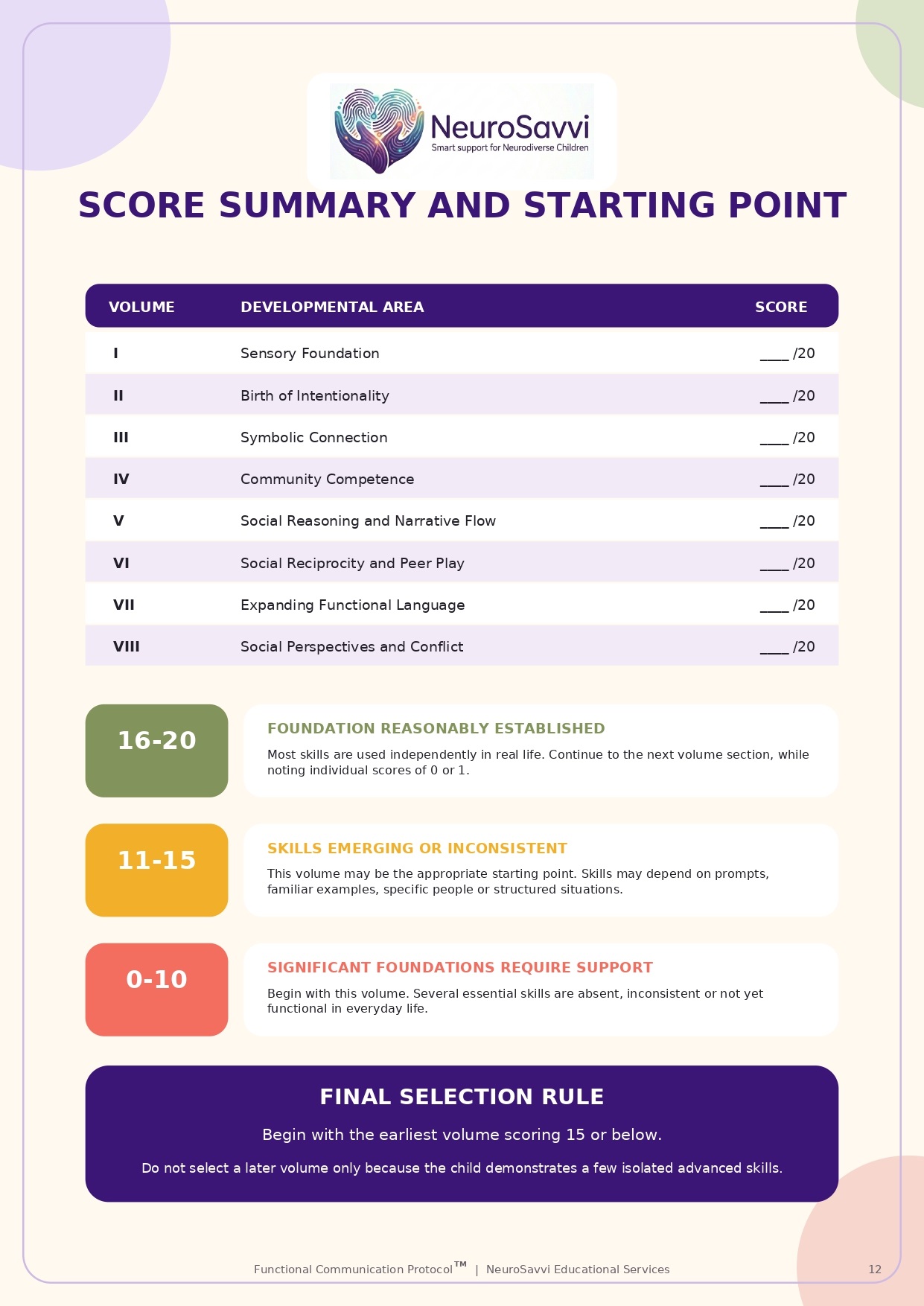
Score Summary
| Vol | Developmental Area | Score | Status |
|---|---|---|---|
| I | Sensory Foundation | 0 / 20 | Pending |
| II | Birth of Intentionality | 0 / 20 | Pending |
| III | Symbolic Connection | 0 / 20 | Pending |
| IV | Community Competence | 0 / 20 | Pending |
| V | Social Reasoning and Narrative Flow | 0 / 20 | Pending |
| VI | Social Reciprocity and Peer Play | 0 / 20 | Pending |
| VII | Expanding Functional Language | 0 / 20 | Pending |
| VIII | Social Perspectives and Conflict | 0 / 20 | Pending |
Recommended Starting Point
Parent Reflection and Recommendation
Recommended Starting Point
Parent-guidance screening tool | Not a diagnostic assessment · Functional Communication Protocol™ · NeuroSavvi Educational Services